Let's Connect!

Subscribe to the email list to stay connected.

What is your long-term vision for Elbert County?

Elbert County is embarking on the exciting process of updating its Comprehensive Plan, a crucial roadmap for the county’s future. This plan serves as a long-term vision, guiding decisions on land use, infrastructure, housing, and environmental preservation while ensuring the community’s values and priorities are at the forefront.

A Report to the Community - Update from Planning Commission Chair Kevin Kirkwood

Listening to the Community. Protecting What Matters.

Elbert County’s Comprehensive Plan is being refined by the Planning Commissioners to better reflect what residents have consistently said they value most: rural character, open space, working farms and ranches, responsible use of water, safe communities, and growth that fits the County rather than reshapes it.

The Planning Commission has invested more than 30 hours in working group sessions to carefully review the plan, test policy language, and respond to the needs of the community it serves. That work has moved the document beyond broad planning language and toward a clearer, more practical expression of local values.

The Commission now has two chapters remaining to review, along with the appendix and a final review of the Future Land Use Map (FLUM). With that work underway, our Comprehensive Plan update process is expected to be completed by October. A public hearing is anticipated in late October or early November, at which public comment will be welcome.

The updated plan does not reject change. It gives change a clearer standard. Future decisions should protect the qualities that make Elbert County distinct, use existing planned capacity responsibly, and ensure that development is supported by water, roads, emergency services, and sound fiscal planning.

Changes We Recommend

The core plan is being strengthened around a preservation-first approach. Rural character is no longer treated as a general aspiration. It is now a practical guide for land use, infrastructure, housing, environmental protection, and public investment.

The revised plan places greater emphasis on:

  • protecting open landscapes, agriculture, wildlife habitat, and dark skies
  • directing more compact housing toward municipalities and serviceable areas
  • recognizing that existing planned housing capacity is already substantial
  • treating water, wildfire, flooding, emergency access, and service capacity as real planning constraints
  • ensuring roads, utilities, and public facilities support existing residents and already planned areas
  • encouraging economic development that fits the County’s rural identity, including agriculture, small business, remote work, and community-serving uses

These changes make the plan more disciplined without making it less practical. Growth remains possible, but it must be appropriate, supportable, and consistent with the County’s long-term vision.

Community Values More Clearly Reflected

Public input throughout the planning process emphasized the importance of quiet roads, open views, wildlife, safety, community identity, and the ability of future generations to experience the same natural beauty residents value today.

The Planning Commission’s working group process gave those values sustained attention. More than 30 hours of review allowed commissioners to examine the chapters in detail, align policies across the full plan, and ensure the final direction reflects community priorities rather than generic growth assumptions.

The environmental and community resilience chapters were strengthened to better connect water, flood risk, wildfire, wildlife, and emergency access to land use decisions. Community resources were also reframed around the realities of a large rural county, including long response distances, volunteer service capacity, shared facilities, and regional partnerships.

A More Responsible Approach to Growth

One of the most important changes is a clearer distinction between managing growth and promoting it.

The revised plan recognizes that Elbert County already has significant planned housing capacity. That means the County can be more selective about where additional development belongs and whether it is truly needed. The focus shifts from expanding land supply to making better use of existing plans, protecting rural areas, and avoiding development patterns that create long-term costs for taxpayers and service providers.

This approach supports housing choice while acknowledging that not every housing type belongs in every part of the County. More compact or affordability-focused housing is generally better suited to municipalities and areas with infrastructure, while rural areas should continue to reflect rural densities and service expectations.

Water and Public Safety Come First

Residents repeatedly raised concerns about water, wildfire, roads, and emergency response. The revised plan responds by making those issues central to development review.

New development should demonstrate:

  • adequate long-term water supply
  • safe and reliable emergency access
  • realistic fire and evacuation planning
  • compatibility with rural roads and service capacity
  • protection of drainageways, floodplains, and natural systems
  • a fair contribution toward the infrastructure and services it requires

This is not anti-growth. It is pro-accountability. The County should not approve development first and discover the public cost later.

Stronger Alignment Across the Entire Plan

The revisions also improve consistency from chapter to chapter.

The FLUM now has clearer policy weight. Economic development is more closely tied to agriculture, local business, and compatible employment. Infrastructure investment is focused on safety, maintenance, resilience, and existing communities. Funding tools are framed as ways to implement the plan, not as reasons to pursue projects that conflict with it.

Even the glossary was revised so important terms such as rural character, controlled growth, housing capacity, and rural service expectations support the same overall direction.

The Result

The updated Comprehensive Plan reflects substantial public input, detailed technical review, and more than 30 hours of Planning Commission working group sessions.

With two chapters, the appendix, and the final FLUM review remaining, the Commission is in the final stretch and expects to complete the process by October.

It says Elbert County can remain rural, protect its natural and agricultural assets, support families and local businesses, and still make room for thoughtful change.

Listen to the community. Protect what residents value. Plan carefully enough that future generations inherit those same choices.
What is a Comprehensive Plan?

 A Comprehensive Plan is a strategic blueprint that helps communities shape their future. It outlines goals, policies, and priorities for development, striking a balance between growth, sustainability, and the quality of life for residents. Typically spanning 20 years, the plan provides direction for future zoning regulations, transportation improvements, economic development, environmental conservation, and capital investments.

By updating the Comprehensive Plan, Elbert County ensures that it remains a thriving and well-balanced community, one that addresses the needs of its residents while preserving its rural character and natural beauty.

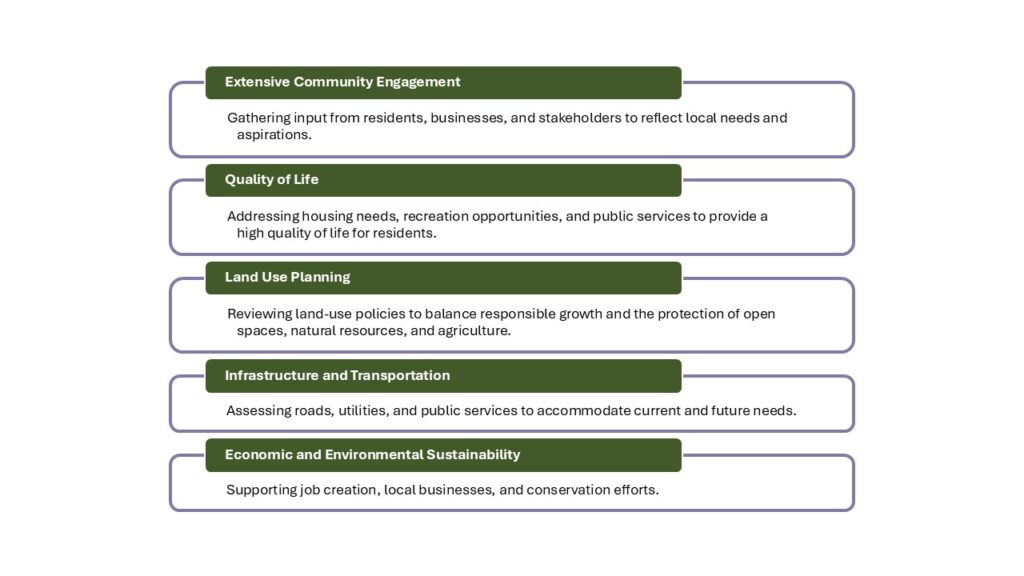
The Comprehensive Plan addresses the following topics:

Community Engagement

Community engagement is crucial to the success of implementing the Comprehensive Plan, as the Plan should reflect the community’s needs and vision. To achieve this, there will be a series of opportunities for community engagement. The goal is to reach as much of the Elbert County community as possible.

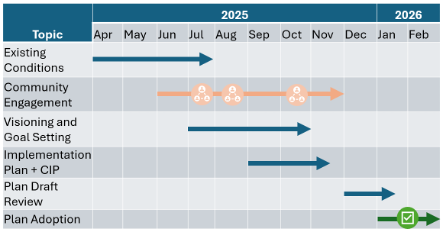
See the timeline below for project happenings and opportunities to meet with the Project Team!

Comprehensive Plan Steering Committee

The Board of County Commissioners has appointed 16 Steering Committee members to guide the development of the Comprehensive Plan by offering input, reviewing draft materials, and ensuring the plan reflects the community’s goals. Steering Committee members represent long-term residents, new residents, landowners, business owners, and local professionals, bringing a wide range of perspectives to the table. Their collaboration helps create a plan that is practical and rooted in the community’s shared vision.

Steering Committee members:

Andrea Richardson
Chris Hatton
Danny Willcox
Jeanine Foster
Jim Marshall
Joe Pepper
Ken Madsen*
Kevin Kirkwood*
Kim Wills
Larry Gable
Lee Benjamin
Nicole Hunt*
Pres White
Shelly Manning
Steve Balcerovich
Tyler Dreisbach

*Planning Commissioners

Steering Committee meetings are open to the public for viewing and listening. Meeting dates, times, and locations are posted below a week in advance.

Community Survey Overview

A successful survey represents the collective voice of the community. This means ensuring that all segments of the community are provided with the opportunity to provide their thoughts and ideas. The County and project team made extensive efforts to ensure that as many residents as possible had access to both digital and print options to take the survey. Distribution included:

  • Online access via the Comprehensive Plan Project Website
  • In-person outreach at the Elbert County Fair and Simla Days with print copies available
  • Social media promotion on the Elbert County Government’s Facebook page
  • News Articles:
    • The Elbert County News Flash
    • Colorado Community Media
    • Denver7 (ABC)
  • Paper copies available at:
    • Pines & Plains Libraries in Simla, Elbert, Elizabeth, and Kiowa
    • Elbert County DMV
    • Elbert County Fire Rescue
    • Elbert County Admin Building

The Community Survey was open from July 22 – September 5, 2025, and it collected a total of 925 responses, of which 868 were from Elbert County residents, representing 94% of total survey participants. 

(Note that not all 925 survey respondents answered each and every question. The Full Survey Results include the number of respondents who chose to answer or skip each question. The first two questions were the only ones that required an answer in order to move on.)

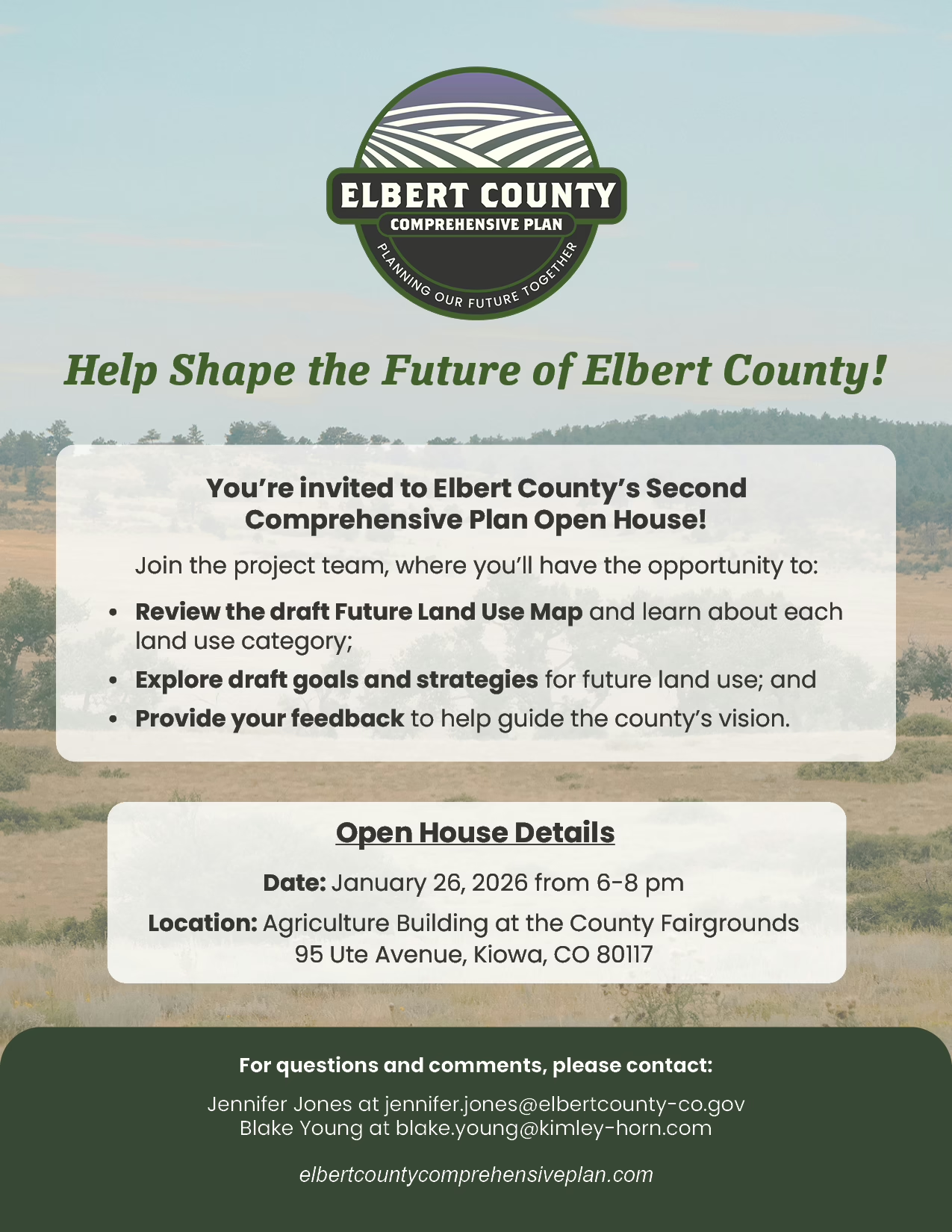
Open House #2 - Draft Future Land Use Map

A second Open House was held on January 26, 2026, to share the Draft Future Land Use Map with the community, explain the land use planning process, and gather public input. Attendees explored a series of informational boards and participated in interactive activities to provide feedback.

All boards presented at the Open House, including the Draft Future Land Use Map, are available below.

What’s Next?

The Draft Future Land Use Map, along with a summary of community feedback, will be presented to the Comprehensive Plan Steering Committee, the Planning Commission, and the Board of County Commissioners for review.
Revisions will be completed following comments and direction.

Frequently Asked Questions

No, the Comprehensive Plan does not directly change zoning. The future land use map will assist in guiding future development decisions; however, County Regulations would not be amended upon Plan adoption. The Plan serves as a guiding document to identify where land use types are appropriate and guides future updates to the Zoning and Subdivision Regulations.

Land use refers to how land is actually utilized (e.g., residential, agricultural, commercial), while zoning refers to government regulations that dictate how land can legally be used.

The following topics are covered in the Comprehensive Plan:

  1. Comprehensive Plan Vision
  2. County Character
  3. Land Use and Strategic Growth
  4. Housing
  5. Transportation
  6. Parks, Trails, and Open Space
  7. Natural Environment, Sustainability, and Resilience
  8. Infrastructure and Utilities
  9. Public Safety and Wellbeing
  10. Community Resources

To stay informed, please visit the website regularly and attend community engagement events to share your input on the Plan. You can also provide your email address through this site to be added to the project’s email list to receive project updates.

The Comprehensive Plan process will go through 2025 and conclude in early 2026. 

Resources

Contact us!

What ideas would you like the team to consider for the Elbert County Comprehensive Plan?

Community input is a key component to developing a Comprehensive Plan. Share your input with the team using the form.